The last week here in Dorset has seen some stunning weather an the summer species are starting to kick into gear, I’ve been determined to find time to get out on the water and not let this stupid panic buying of fuel effect me to much, yes I had to sit in traffic for 30 minutes to make sure I have enough fuel for the weekend, an after a 3 hour session I had today I’m certainly glad I did. After a few emails and many informative phone conversations with Sean Mcseveney regarding all things Lure fishing and sea fishing, I was inspired to get out on the rocks and chuck the soft plastics out for the wrasse, especially after reading the reports of his first lure caught wrasse on soft plastics, if your heading to Dorset this summer be sure to check his blog out here at Fishing Tails, Sean is keeping up to date fishing forecasts and catch reports in the Dorset area and is very very handy to anyone unfamiliar with the Dorset coast.
I’ve struggled over the last year to find the wrasse on soft plastics at Portland bill, I’ve used bait many times and had plenty of fish on rag worm, limpet, and peeler crab, but the soft plastic loving wrasse kept evading me. But after talking to Sean who stated that he had luck using emerald Megabass X layers with a 3.5g worm weight, I rigged up the same and within 5 casts this wrasse of around 3LB slammed my rod tip over at my feet. I saw the fish follow the lure up on the cast before but I thought it was a Pollock till the rod bent double. Luckily Karl had just turned up to take this photo, cheers mate.
After the first fish I kept moving around trotting my lure along gullies and dropping it over ledges, I kept getting bites right back to my feet but couldn’t find another hook up until I dropped the lure out at distance on the crease of the ripping current that was hammering past the Bill. Again the bites were there good an strong an lures were coming back covered in bite marks. It wasn’t long an the second fish was landed. Smaller than the first but the fish was stunning orange an dark red.
Moving on a few more rocks the bites dropped off as the current pushed further out, it seemed the fish were using the boulders as ambush points waiting for prey to drift their way very similar to the bass in summer. The problem I found when fishing at range isn’t the casting or lack of lure control but controlling a fish that wants to dive harder then hell as soon as it knows its hooked. This third fish dropped the anchor on me 3 times before it gave up, remembering that when these fish go to ground give them a couple feet of slack line an wait, 9 out of 10 times the wrasse will soon come out of its hole an your line will tighten and the fight continues. Unlike bait fishing with a sinker that gets snagged up, its just rod, line, hook an fish. Keep it simple an gain more fish an less tackle loss. Simple.
I had one more fish after this but my phone battery had died an I couldn’t get a photo, shame as it was another stunning orange wrasse like the second. I was starting to put pieces of the puzzle together on the drive home, starting to see where I have been going wrong. 1) I have been using 10g an more worm weights, this could be effectively not letting lures like the x layer work effectively. A 3.5g weight an 4.5inch lure will cast more than far enough to find wrasse. 2) conditions were very very calm where I was fishing today, unlike searching out the turbulent water where the bass feed.. 3) water clarity was unbelievable today, thinking about it I’m surprised I didn’t see any divers out there today. 4) the lure colour Emerald purple, I’m sure I read a on the JerseyBassGuide forum that at a certain time of year some species of lobster, crayfish, an crab turn a light purple colour. I think a trip to the sea life centre is in order..
I have to say a big congratulations to Lauren who yet again pulled it out of the bag last week with her first lure caught rock pig, I blanked that day and after handing my HPR to her for 5 minutes she pulled this mini steam train out..
Well I’m hoping there is nobody at home while I upload this blog post because conditions seem almost to good to be true, a WSW wind, spring tides and high pressure, after a quick walk round a few local marks the water clarity has that gin clear colour we all wish for.. Check out this video I took at Portland Bill Late Thursday morning (I heard some guy apparently had a double earlier in the morning at the bill, not surprised with conditions this perfect! P.s. I also heard a well know angler caught some wrasse on SP as well… Well done that man!!)
Does it get any better?? Yup if only I didn’t have man flu! Like most anglers stuck at home, I have to do something fishing related be it service the reels, sharpen hooks or repaint some lures. But I decided to take a trip down the tackle shop an grab some new shads an hooks and show you guys some of my prep work before the season starts..
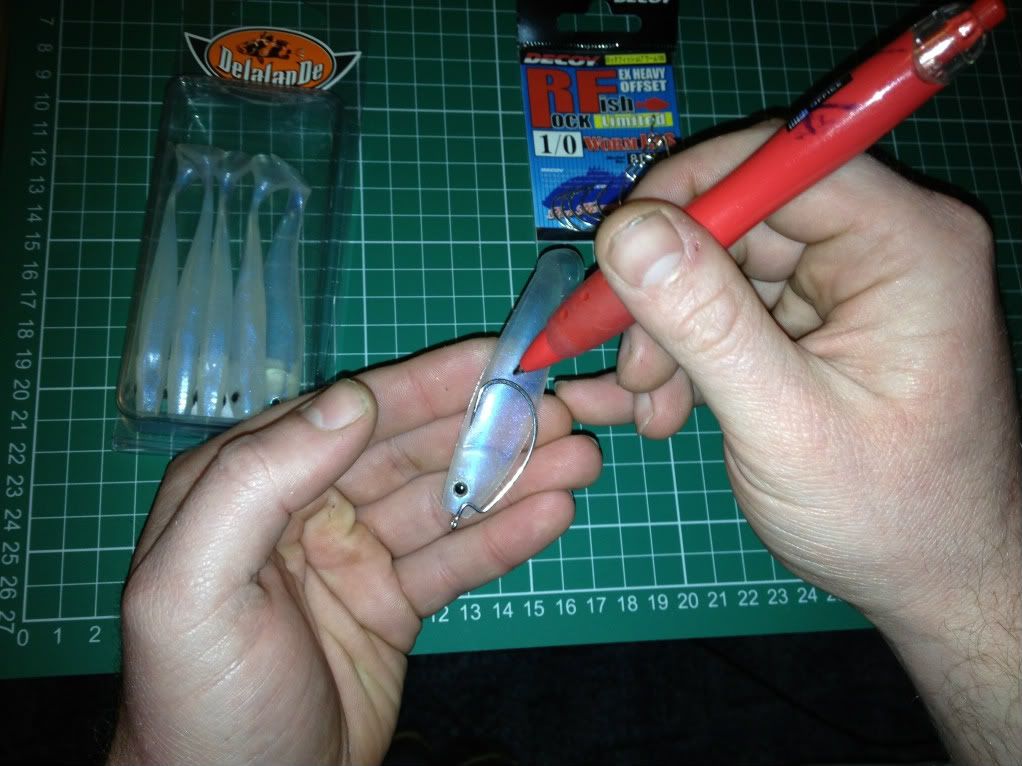
I’m rather pedantic an OTT over my preparations when lure fishing and everything has to be perfect from step 1, If I can afford to buy Hard lures for up to and over £20 then I can put that extra effort into rigging up my soft plastics an getting the best from them. I’m using here the Delalande 6 shad GT 9CM in Nacre Bleute with Decoy Ex Heavy Offset Rock Fish hooks size 1/0, when buying hooks and lures like these I like to pair them up in the tackle shop, Buying online can be a gamble unless you know from experience the tackle you are buying pair up nicely.
A few bits are missing in this photo… but you will need, hooks, shads, pen, sharp knife, Vaseline.
Firstly I like to sight up the hook with the shad, and mark up the curve of the hook length maintaining the bend of the hook is within the 1/3rd to ½ the length of the lure. Then mark a diagonal line back to the hook shank. Be sure not to take this cut to far forward as to leave plenty for the hook to pierce the nose of the lure.
Next take your sharp knife an make the cut, I like to use a scalpel as the blades are thin an a more accurate cut can be achieved. Try to keep the cut central and neat as an angular cut can cause the hook position to twist the lure body creating an uneven swimming pattern.
Next up thread your hook through the nose of the lure and back through the belly slice, again make sure your hook is central.. I’m a firm believer that the curve of the hook acts as a vane an assists casting distance and accuracy. I like to fill up the belly slice and coat the hook point with Vaseline ensuring that the hook can cleanly move through the lure when a fish bites, also if skinning the hook point in the lure will allow for a clean application. Also Vaseline comes in all colours and flavours, here I’m using the Rose Vaseline creating the impression of stomach in the lure. Plus the added flavour?? Who knows it might help catch a few fish. You will be surprised at how long Vaseline will remain inside the lure.. I’ve used the same lure for around 60 casts and that belly is still full..
When I’m feeling on top form again I shall show how I rig an weight this set up out on the water..
Just a quick update on the new Quantum EXOpt reel… I’ve had no problems what so ever with this reel, 3 months of heavy use and the reel is still dead smooth and the line lay fantastic, I haven’t had one wind knot with Nanofil or YGK PE braid. All was going well until this happened…
From what I can see looking at the replacement provided by Chesil Bait n Tackle there is a single snap ring holding the casing and bearings in place.. I have no idea what could have gone wrong, maybe the snap ring was a lose fit.. I would have reassembled the casing but all the internal parts ended up in the drink.. Doh!
Until the next time guys I got a bad case of man flu to nurse..
Just thought I’d put a link up for THE LUREFAIR 2012 at Derby University on the 28th of April. Britain really needs more shows like this especially in the South West. If you have the day off and are local then please come along and support the lure angling communities, all the information can be found on the home page (click here). Hope to see some of you guys there..
I went to the County Game show at Shepton Mallet last year and had a blast walking round the fly fishing stands, but I was frankly disappointed at the amount of stands representing the lure fishing market. You only need to scan the forums and online shops to see how bass fishing, HRF and LRF are taking off in the uk and abroad.
When I’m out on my travels along the coast, I keep coming across more and more anglers switching over from the mainstream Course fishing, Sea Bait fishing an Fly fishing and enduring the harsh terrain and challenges of Bass Fishing. Its these anglers I take my hat off to, to take a step out of the norm and setting them selves new challenges is inspiring in its self. When I first moved to Weymouth the ocean was like the ultimate challenge for me, I spent days sat behind rod rests chasing carp or watching a float on the harbour, but put a lure rod in my hands and let me walk miles of coast line and I am never more happier..
I Cant emphasize how much I get a kick out of fishing LRF, for a method so simple and adaptable, it doesn’t take much to learn a few tricks and bag a few fish. the fact that the air temperature has dropped below freezing this weekend and the wind has swung round bringing the cold air from the North East, LRF was in my opinion my best chance of a fish or two. I also had a chance to pass along the little knowledge I have of this style to an old school friend of mine and partner in crime Lauren. Who is more used to hauling up fish on a boat or using a tree trunk to find mackerel on chesil. I wasn’t sure she would like the concept of standing at the harbour side in -3 conditions. But she stuck at it until we both couldn’t feel our feet and fingers anymore. She’s a Trooper!
We decided we could get out of the harsh as nails winds by fishing the south side of the Weymouth pleasure pier and taking shelter on the small steps in front the condor. I’ve fished here many times fishing LRF and had plenty of Pollock on small hard lures and SP`s. One of my favourite lures to fish this mark is the Savage gear prey 69 lure for mackerel and school bass in the summer using light tackle.
I decided to make a few changes to my standard routine, keeping things as simple as I can not to make things to complex for Lauren to learn I decided to use 1g size 6 jig heads with a size BB split shot 2 inches up the 2LB fluorocarbon leader. The one last major change I made from the norm was to use ragworm instead of sp`s, reason being I didn’t want to waste time showing Lauren different retrieves and swapping and changing lures.. I wanted her to feel for shy bites in the dark and not to rely on watching a rod tip. It didn’t take her long before she pulled out her first ever LRF caught fish the humble Pollock. She played this fish like a pro, and it was a welcome sound to hear the spool spinning as this fish dived amongst the wooden pier stands.
A few things that we noticed as the night drew on was the different depths that different species were feeding. Pollock were feeding very high up in the water, deeper than 5ft an all we could catch where micro Pout, to trigger a bite from the pout we had to activate the rod tip with a 6 inch sink and draw letting out a little more line every few lifts of the rod tip.
After a few hours of Pollock and Pout I decided to fish the jig head on the bottom, I mention earlier that we used a BB split shot 2inches from the jig, reason for this was when fishing on the bottom, the heavier BB hits bottom first effectively letting your lure sink more naturally and to rest on top of any weed and snags..
After a few cast this stunning Rock goby rattled our rod tip. I haven’t ever seen a goby with such a bright dossal fin before, makes me think a little harder on what colour lures I might try using next time I go out with the HRF gear….